Well water treatment
Methane & Dissolved Gas Removal: The Mini-Degasser
Methane, excess CO2, and dissolved oxygen in well water cannot be removed by softening or filtration alone. The Mini-Degasser is a custom-engineered, in-house built system that aerates and vents dissolved gases safely before treatment continues. Engineered and assembled by us in Central Illinois.
System overview
Five stages, one compact unit
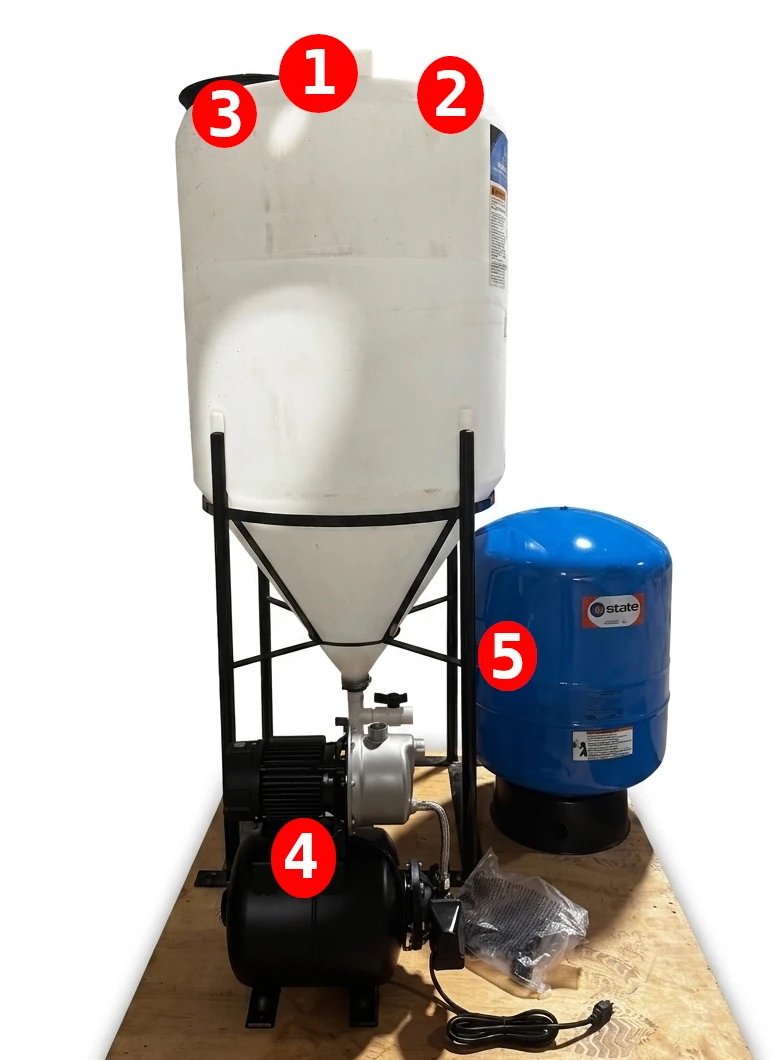
Every component ships as a single assembled unit, built and tested at our shop in East Peoria before installation. The numbered callouts on the image correspond to each treatment stage described below.
The problem with dissolved gases
Softeners and filters do not remove dissolved gases
Methane and excess CO2 in well water are dissolved under pressure. When water enters a home, that pressure drops, and the gases come out of solution. Methane is flammable. Excess CO2 lowers water pH, which accelerates pipe corrosion and can interfere with the performance of downstream treatment equipment. Neither can be addressed by standard filtration or softening.
The correct approach is to drop the pressure in a controlled environment, allow the gases to separate from the water, and vent them safely to the outside before the water moves forward in the treatment train. That is what the Mini-Degasser does.
- Methane is flammable and must be vented outside, away from ignition sources
- Excess CO2 lowers pH and accelerates corrosion of pipes and equipment
- Dissolved oxygen imbalance can accelerate iron oxidation and fouling
- Standard filters and softeners cannot address dissolved gases
- Aeration is the correct first step before iron, tannin, or hardness treatment
Testing first
Dissolved gas problems are confirmed through water testing and on-site assessment. We test before recommending this or any other system. If your well water smells, foams at the tap, or has caused unexplained pH issues or corrosion, those are the signs worth investigating.
The Mini-Degasser is engineered and assembled entirely by us in Central Illinois. It is not a third-party product. Every installation is configured for your specific site and water chemistry.
How it works
Five stages, one treatment pass
Each stage handles a specific part of the problem. Aeration liberates the gases, peroxide injection disinfects and oxidizes, passive venting clears the liberated gases safely outside, and the jet pump and pressure tank restore full working pressure before water continues downstream.
Aeration
Well water enters the top of the 130-gallon atmospheric tank and drops freely. The fall breaks surface tension, liberating dissolved methane, CO2, and balancing dissolved oxygen. An internal circulation pump continually loops the water volume to eliminate stagnant spots.
Hydrogen Peroxide Injection
Dosed actively within the tank loop. Hydrogen peroxide safely disinfects the water supply and oxidizes dissolved iron and manganese for downstream mechanical filtration, breaking down cleanly into harmless oxygen and water with zero residual chlorine taste or odors.
Passive Venting
Displaced air carries liberated gases out of the vessel through a dedicated vent line connected to the exterior of the structure. Natural displacement drives the process — no fan or electrical components in the vent path, eliminating ignition risks near flammable gases.
Repressurization
An integrated jet pump draws treated water from the base of the degasser tank and forces it into the pressure tank network, instantly restoring working household line pressure.
Tank Storage
A 60-gallon pressure tank ensures an uninterrupted water supply for immediate use throughout downstream filtration stages and building taps.
System specifications
What the system consists of
| Component | Detail |
|---|---|
| Aeration tank | 130-gallon atmospheric tank |
| Circulation | Internal circulation pump, eliminates stagnant zones |
| H2O2 injection | Dosed actively within the tank loop |
| Venting | Passive, dedicated vent line to exterior, no fan |
| Repressurization | Integrated jet pump |
| Pressure tank | 60-gallon |
| Target gases | Methane, CO2, dissolved oxygen |
| Disinfection | Hydrogen peroxide, zero chlorine residual |
| Typical position | After POE sediment filtration, before iron/softening |
| Applications | Private well, agricultural, livestock |
| Origin | Engineered and assembled in Central Illinois |
The Mini-Degasser uses hydrogen peroxide rather than chlorine for disinfection. The peroxide oxidizes iron and manganese for downstream capture, disinfects without leaving a chemical residual in the water supply, and breaks down into oxygen and water. There is no chlorine taste, odor, or byproduct introduced.
The circulation pump is what separates this system from simpler aeration tanks. Without circulation, water in a large tank can develop zones where incoming peroxide mixes unevenly. The circulation pump keeps the entire volume of water moving, so peroxide contact is consistent throughout and no untreated water reaches the outlet.
- No chlorine introduced at any stage
- Passive venting with no fan and no ignition risk
- Circulation pump ensures uniform peroxide contact
- Jet pump restores full working pressure
- Sized and configured for each installation
Where it fits
Treatment train placement and downstream systems
The Mini-Degasser sits between point-of-entry sediment filtration and iron or softening treatment. Sediment filtration before the degasser protects the tank and pump from particulate. The aeration and peroxide dosing that happen inside the system oxidize dissolved iron and manganese, which downstream Greensand+ filtration then captures. Softening follows.
Exact placement can vary depending on what the water chemistry calls for on a specific job. We assess each site before specifying the treatment order. Wells with dissolved gas problems often have other issues alongside them — iron, manganese, tannins, or arsenic are common combinations in Central Illinois groundwater, and each requires its own treatment stage in the train.
- Positioned after POE sediment filtration
- Before Greensand+ or iron filtration
- Before softening and carbon filtration
- Hydrogen peroxide injection integrated into the system
- Placement confirmed by water chemistry and site assessment
For more on the hydrogen peroxide treatment approach, see our hydrogen peroxide treatment page. If your well also has iron or manganese staining, see our iron and sulfur treatment page. For arsenic, see our arsenic in well water page. For yellow or tea-colored water, see our tannin treatment page. The well water treatment hub covers iron, manganese, tannins, hardness, arsenic, and bacterial treatment options together.
Typical treatment order
- 1 POE sediment filter — removes particulate before the degasser
- 2 Mini-Degasser — aeration, H2O2 injection, passive venting, jet pump repressurization, 60-gallon pressure tank
- 3 Greensand+ filtration — captures oxidized iron and manganese
- 4 Softening / carbon filtration — hardness and taste/odor
- 5 RO at drinking tap — final polishing for drinking and cooking water
Exact order varies by site. We assess before specifying.
Frequently asked questions
Mini-Degasser questions
Get in touch
Dissolved gas in your well? Start with a test.
We bring testing to you at no cost. Drop your name and number and we will reach out, usually the same day.
Your information is never sold or shared.
Based in East Peoria, IL
173 Thunderbird Lane
East Peoria, IL 61611
Mon-Fri 9am-4pm
We serve Central Illinois well water customers throughout Peoria, Tazewell, Woodford, McLean, and Fulton counties. Free water test on your first visit.